
Coach: Gary Stead (Part Three)
This interview took place after NZ's historic Test Championship win against India in 2021.

At the end of our second ‘interview’ before the Test Championship final, Gary joked that I could subtitle his piece, ‘The Bridesmaid.’ I have to find another subtitle now.
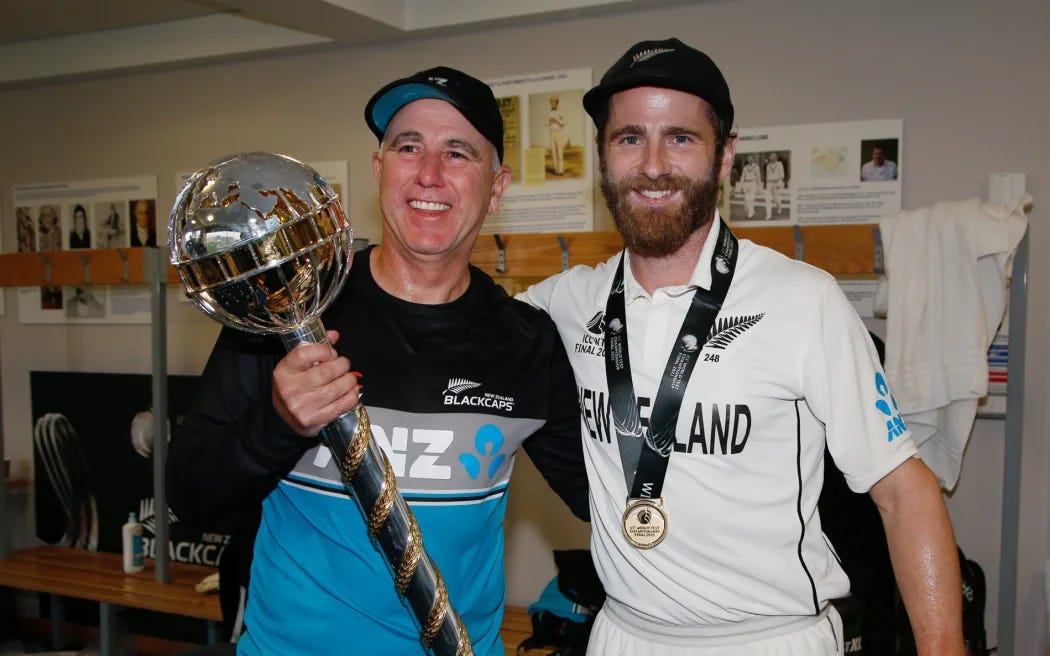
I've been to four World Cup finals before and come second in every one. So for me, winning was a relief, but it was also a relief for the team as a whole. A number of the guys had been in both the Melbourne and Lord’s World Cup Finals and had come so close - at Lord’s anyway. It was amazing to be a part of the win - I’ll never ever forget that day. I've seen grown men cry with happiness as they finally got over the line. I don't know, it's hard to describe - but there was pride in what we'd achieved. I guess that's why you play sport - to be the best and for that short period of time, we were.
I asked Gary to take me back to the final. Sacrilege: I hadn’t watched any of the game.
It was a six day Test. We had two days completely washed out so essentially the game was done in four days. We turned up on the last day and they were two down and only 30 runs behind so it could have swung either way. The pitch was obviously going to turn, so batting was going to be hard work. We thought if we could get Kohli early, we would put them under a lot of pressure - Jamieson nicked him out which was nice. We dismissed Pujara soon after and got on a bit of a roll, but when Tim Southee dropped Rishabh Pant, a dangerous player, I thought, ‘I hope it's not the chance that we need.’ But we kept at it, and then Ross and Kane came together and batted beautifully at the end under the highest pressure. In terms of tension, I think it was certainly as great as the World Cup Final.
What was the difference?
When you play a Test match, that tension is stretched - over six days in this case. You know their spinners are their strength and will come into play more and more as the game goes on. We were about 40-2 chasing 140. Most coaches say, ‘Put two wickets on the score.’ I wouldn't have wanted to be 40-4, chasing another hundred on a difficult wicket, and you know that Kohli has the ability to lift their team. It was tense. We had two dressing rooms because of COVID. We had an upstairs room - all the coaches were up there, with only three players, I think. The rest were downstairs. After we lost a couple of wickets, I said, ‘I'm not sitting here any longer. I want to go down and make sure the guys are trying to be calm.’ I found a spot and we started to make some runs. I ended up sitting there with Tom Latham next to me and we didn't move the whole time. I never really felt safe because time was coming into it as well - going into the last hour (the last ten overs) of a Test match is pretty unusual. It felt like Lord’s all over again - I left my book and pen upstairs and thought, ‘It doesn't really matter now.’ My major goal was to calm everyone down and just make sure we were focused on what needed to be done.
And were they calm?
You’ve been in cricket teams, mate. You know what bowlers can be like. Our bowlers are a great bunch of guys but there was a lot of nervous chat going on, and the closer you get, the more people think, 'We're going to do this!’ Then you make it … It was exhilarating but as I said, also tinged with relief. The first New Zealand men’s team to get over the line - it was an amazing feeling. There might have been 200 Kiwis there - it was like a Phoenix soccer game - shirts off. Naturally, you know a few people in that group and while small in number, it was great to share that moment with them. I sat back and I just thought, ‘How can we achieve this with so few resources?’
There's a whole host of reasons why and I don't know what they all are, but a win such as this takes a long time. It might be a two-year competition, but it’s more like a 6-7 year project. A lot of parts have to come together, but in that particular final, I think Williamson absolutely showed his class. I think he made 49 and 50 not out on a really tough wicket. Everyone points to Kyle Jamieson who got 7-61 off 46 overs for the match - amazing bowling - but it was the batting that was hardest. To score those runs and to do it with Ross - it was almost meant to be. It didn’t feel like it at the time, though - Ross was dropped early on but he pushed through that tough time. The other guy who stood out for me in that final was BJ Watling. He retired at the end of it. He played, or tried to play with a broken finger in his hand, had an operation when he got home and retired. That's how much it meant to him. For me, he never received the accolades that he deserved, but he epitomises what the team is about - humble, quiet, hardworking. The tears showed how much it meant and in some ways marked the disappointment that they'd been through in two World Cup Finals. When you get to that very elite level, you might wonder, ‘Will I get this chance again in my career?’
We've never talked about being number one, but we find ourselves at number one in two formats of the game and number three in the other. As I said, there are a lot of reasons why, but it's not because we need to be number 1. I think we have internationally mature players that were ripe for the picking at the same time, but there are also some things sitting behind the team such as a stronger New Zealand ‘A’ programme than we've had in the past. It has helped us grow players like Jamieson, Conway, Daryl Mitchell, Will Young. Those people have all come into the team and performed right from the very start. Consistency around selection has also helped. They know that one bad performance doesn't mean the end of them. I think there are other environments where it’s ‘Me first and team second’ - self-preservation. I hope our players can be themselves and feel supported in that. I also know that people before me have helped shape our success. Brendon [McCullum] and Hess [coach Mike Hesson] helped create the culture.
What’s next?
I was actually looking through it today, JP. No team has ever held two World Championships at the same time in different formats. I mean that would be great if we could achieve that, but you need a little luck for that to happen. So for us now, it's reviewing why we've got here and then making sure as an organisation we can try and replicate those lessons for the future. New Zealand is never going to be as well-resourced as other countries. We don’t have the population either, so what are the four or five most important things and then how do we invest back into those? How do we ensure that the next group coming through - after your Williamsons, Taylors, Boults and Southees leave - can be as successful? There’s a review taking place now. What has happened over the last 10 years to allow us to get to this point? That’s the thing that really interests me.
I think one of the biggest challenges for our team will be how we handle the favourites tag. I think we're very good underdogs, we're good at flying below the radar, we're good at talking ourselves down and talking the opposition up, but we’ve been in the finals of each of the last three world competitions. Psychologically, how do we deal with that expectation? There'll be some pressure from self-expectation, but also from the public and fans. Every team is going to want to knock us off our pedestal but I think that's a healthy challenge for us as well.
One of the other questions I ask myself is, ‘Why have we inherently struggled against Australia for the last 15 years? Why do we struggle to beat them in any format?’ That's something that does keep me awake at night. Playing in Australia is difficult - the crowds - they are like a big communal team. I remember sitting at Perth, in the series we lost 3-0. We were hammered, to be fair. We were in the viewing area of the stadium and Kane walked out to bat - it was bloody hot and the abuse that was being thrown at him … You have to be strong to push through that and succeed there. It might wash off his back but other guys might struggle with that. Add the impact of social media these days and mental health - international sport is not an easy place to be for long periods of time.
Our mutual friend, Neil Maxwell, told me that you know how to win.
I look back as a player and I loved the challenge of captaining teams and trying to manipulate games. I enjoyed the tactical and mental side of it. It never drained me - it actually stimulated me to find a better way. But I know my method doesn't work with all players. As a coach, I like to map things out in advance and to say, ‘If we play well, this is where we will get to. This is how we win this game.’ I'm always playing that around in my mind, to think ahead, but I know some of our guys prefer to be in the moment, so that's a balancing act for me. But I do think my job is to continually look at the big picture, while the assistant’s job is to look at the now. I'm looking at where we're going, and how we're getting there: the assistants are looking at the day to day stuff. My role is strategic. I have to tell the assistants that, ‘Your job, at times, is to keep me on task for the day, what we need to do in the now.’ The players don’t always understand what goes on behind the scenes - the planning for each training, how we push this player, how we put the arm around another, who’s having the conversation with that player.
As a coach. I think about this often. If you’re too serious, or have too many expectations, you’ll turn people away, so it's about finding what's right for the individual and working with them to be their best. I’m not saying I'm not demanding, I want excellence, but I want to do it on their terms because Kane operates very differently to Ross Taylor or Tom Latham. It's a difficult balance. How do we keep moving the group forward? And maintain relationships as well. I use the analogy of moving a glass of water. It's about trying to keep the glass full, and moving forward without spilling the water. If you push too hard you lose water, then you go backwards. You're only progressing at a very slow pace because when you get to the elite level you don't make massive changes or gains. Players have made it because of the skills and qualities they already have. It’s about how we tinker around the edges and keep pushing slowly. It can be innocuous conversations that might just flick the switch. Sometimes, maybe I don't even know that it's happened.
I've always been proud of the team. I'm extraordinarily proud now of where we have got to, so in a way you feel fulfilled. We did something I didn't know we could, something that’s never been done before. I mean it’s nice that we're ranked one in Tests, one in ODIs and three in T20s but the rankings change all the time. My challenge to the team is, ‘How do we maintain being in the top three across all formats?’ Then you will know you are being consistent over a period of time. Kane has proven that as a player - he’s a freak. I'm looking forward to watching the next player in New Zealand that is as good as him. He hasn't got all the records yet, but it won't be long. And he’s a humble individual who does everything he can to make himself better.
There are a lot of coaches and great players who go through careers and never win anything. Look at South Africa. They have never won a world title. How can that be? With the population and skill that they have had. I take satisfaction from the fact that you finally see New Zealand's name is up there and it will be forever. As much as we're moving on to the next thing now, it still makes me smile.
I just hope it doesn’t end up like hockey’s 76
It still makes me smile too :) fantastic conversation, thanks to both of you.